top of page
All is Full Of Love
Post Human Identities and the Case Study of Bjork
As the cycle of life dictates, things evolve as the years go by. We as humans over the decades have advanced in multiple aspects but there is one that overtakes us by the right-hand side and that is called technology. Normally it takes a long time for something so difficult to accomplish to evolve this fast but before we know it, technology has become an indispensable factor in our lives.
This leads me to talk about identities, but above all posthuman identities. Posthumanism encompasses a broad spectrum of ideologies that transcend conventional conceptions of humanity. It postulates that human identity is not subject to biological limitations, but is rather fluid and malleable, capable of integrating with technology to form new modes of existence. In other words, it refers to an entity that exists in a “beyond” state, while remaining human. These identities can encompass beings that have transcended or augmented human limitations through technology, genetic modification, or other means.
It works like post-production, they are concepts related to the idea of changing or manipulating the reality that already exists. A good example is a DJ; someone who takes an existing song and edits it to generate other sounds such as a combination of songs, change of rhythm, and even speed. Although this seems like a very new and innovative concept, it is actually something that has been talked about for a long time.
The Red Hot Chilli Peppers released “Can’t Stop” in 2005 and although the lyrics are not directly about posthumanism, the song is about perseverance, resilience, and an unstoppable life force. It can be interpreted as a metaphor about constant movement and growth that reflects the dynamic between nature and technology where humans are seen to continually evolve and adapt.
Another example would be Marcel Duchamp, a prominent figure in the Dada and Surrealist movements, who was known for his groundbreaking contributions to conceptual art and his challenge to traditional notions of art and authorship. While Duchamp did not explicitly discuss “post-production” as a concept in the same terms as contemporary theorists, his ideas and artistic practices can be interpreted through a postmodern lens, including the notion of post-production. For example, “Ruota di Bicicletta” (Bicycle Wheel), created in 1913, is one of Duchamp’s most famous readymade sculptures. The sculpture consists of an ordinary bicycle wheel mounted on a wooden stool. Duchamp’s concept of the ready-made involved taking everyday objects and presenting them as art, challenging the notion of the artist as the sole creator of meaning. By selecting and presenting ordinary objects as art, Duchamp disrupted traditional notions of artistic production and authorship, highlighting the role of the viewer in interpreting and assigning meaning to the artwork.
This brings us to the contemporary landscape in which many artists like these are involved, especially one so-called Björk Guðmundsdóttir, known professionally as Björk, an Icelandic singer, songwriter, producer, and actress. She is renowned for her distinctive voice, innovative music style, and artistic approach. Her work not only reflects the principles of post-humanism but actively shapes the discourse around it. Björk’s music videos, live performances, and albums serve as sites of experimentation where the distinctions between human, machine, and nature are continually negotiated and redefined. Björk’s lyrics often explore themes of nature, human emotions, and technology, reflecting her interest in combining organic and synthetic elements in her artistry.
Björk’s career trajectory serves as a testament to the fluidity of post-human identities. Her immersive VR experiences and interactive music videos transcend traditional boundaries, inviting audiences to participate in the creation of her art. Through these endeavors, Björk embodies the post-human ideal of transcending physical limitations and expanding the possibilities of human expression.
Malcolm Barnard’s theories, particularly in semiotics, fashion, and cultural studies, can be applied to analyze Björk’s work. His work underscores the idea that identity is not a fixed, intrinsic attribute but a dynamic construct influenced by external factors. Bernard argues that in the post-human era, identity is increasingly mediated by technology, resulting in new forms of self-expression and self-understanding. This perspective is particularly relevant when analyzing Björk’s artistic output, which consistently blurs the boundaries between the human and the non-human.
Starting with Semiotics and Post-Humanism; Björk’s music often incorporates unconventional sounds and structures that challenge traditional notions of music and communication. Björk uses these unconventional elements as signs and symbols to convey post-humanist themes. For example, her use of electronic and synthetic sounds may symbolize the integration of technology into human experience, blurring the boundaries between human and machine.
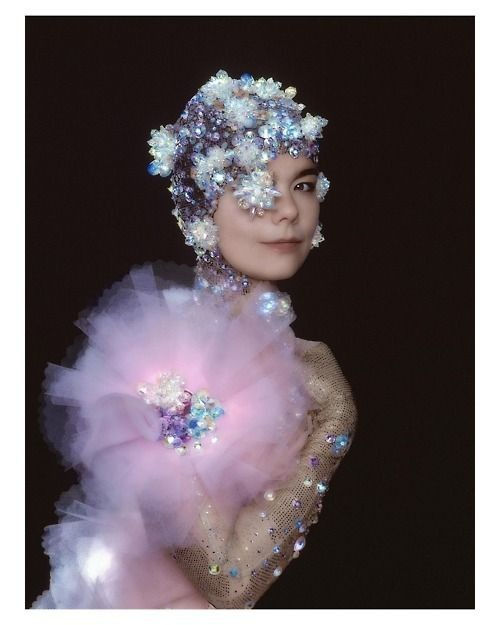
Besides, fashion also plays a crucial role in her work. Björk’s avant-garde fashion choices in her music videos, performances, and public appearances often defy conventional norms of dress and bodily presentation. Barnard’s insights into fashion as a form of cultural expression can be applied to analyze how Björk’s fashion choices challenge anthropocentric notions of beauty and identity, embracing a post-humanist aesthetic that celebrates diversity and hybridity.
Regarding the cultural side, Björk’s is deeply embedded in contemporary cultural discourses surrounding technology, ecology, and identity. Barnard’s approach to cultural studies can help contextualize Björk’s music within broader cultural movements and transformations, such as the rise of cyberculture, environmental awareness, and post-humanist philosophy. By situating Björk’s work within these larger cultural contexts, scholars can gain a deeper understanding of its significance and influence in shaping post-humanist discourses.
Let’s start with cyberculture; Björk has consistently embraced technology as a creative tool. One of the most compelling examples of Björk’s exploration of post-human identity is the music video for “All Is Full of Love.” Directed by Chris Cunningham, the video features Björk as a humanoid robot engaged in a tender, almost sensual interaction with another robot. This visual narrative challenges the viewer’s preconceived notions of love, intimacy, and humanity. The video can be interpreted through the lens of Bernard’s theories, as it exemplifies the dissolution of boundaries between the organic and the mechanical. The robotic Björk is not merely a machine; she embodies emotions, desires, and a sense of selfhood that transcends traditional human attributes. This portrayal aligns with Bernard’s assertion that technology is not an external force acting upon humans but an integral part of our identity formation.
Another example is “Biophilia,” an ambitious multimedia project released in 2011, which represents another significant milestone in Björk’s exploration of post-human identity. Combining music, interactive apps, and educational programs, “Biophilia” seeks to bridge the gap between nature, technology, and music. The project encourages listeners to engage with both natural phenomena and digital technology, fostering a deeper understanding of the interconnectedness of all life forms. From Bernard’s perspective, “Biophilia” exemplifies the post-human ethos by dissolving the dichotomy between the natural and the artificial. The project’s use of technology to facilitate a deeper connection with nature underscores the idea that human identity is not isolated from the environment but is part of a broader, interconnected system. Björk’s innovative use of interactive technology in “Biophilia” illustrates how post-human identities are constructed through a symbiotic relationship with the digital world. These visuals and themes resonate with cyberculture’s exploration of the boundaries between the physical and digital worlds.
Secondly, environmental awareness; Björk has been a vocal advocate for environmental causes throughout her career. Her album “Biophilia” (2011) explores the connections between nature, music, and technology, with each song representing a different natural phenomenon. Björk collaborated with scientists and designers to create interactive apps that accompany the album, allowing listeners to explore themes such as geology, biology, and astronomy.
Last but not least, post-humanist philosophy; challenges the notions of human identity and agency, aligning with post-humanist ideas that critique anthropocentrism and explore the entanglements between humans, technology, and the environment. In songs like “Human Behaviour” and “Hyperballad,” Björk explores human emotions and experiences through non-human perspectives or in relationship to natural and technological forces.
Bernard’s theories of liquid modernity can be applied to Björk’s artistic evolution, highlighting the fluid nature of her identity and the constant renegotiation of her public persona. Whereas traditional sociological frameworks might struggle to explain Björk’s eclectic style and boundary-pushing creativity, Bernard’s approach acknowledges the complexity and dynamism of contemporary identity formation.
The connection this has with fashion is actually pretty big; since fashion plays a pivotal role in shaping post-human identities, serving as a medium through which individuals express their relationship with technology and society. Björk’s iconic garment choices, often characterized by experimental designs and innovative materials, reflect her embrace of technology as a tool for self-expression. From her infamous swan dress at the 2001 Academy Awards to her collaboration with designer Iris van Herpen on 3D-printed garments, Björk’s fashion statements blur the line between the human body and technological augmentation.
Furthermore, the rise of AI presents new opportunities and challenges in the realm of fashion and identity. AI-powered algorithms can analyze vast amounts of data to predict trends and personalize fashion recommendations, revolutionizing the way individuals engage with clothing and style.
Björk’s artistic journey offers a compelling case study for understanding post-human identities through the lens of Malcolm Bernard’s sociological theories. Her work illustrates how technology can be harnessed to expand the boundaries of human experience and self-expression. By embracing the possibilities of the post-human era, Björk challenges us to rethink our assumptions about identity, technology, and the natural world.
In a time when technological advancements continue to reshape our lives, Björk’s visionary artistry serves as a reminder of the potential for creativity, innovation, and interconnectedness. Her work not only reflects the principles of post-humanism but actively contributes to the ongoing discourse, inspiring us to imagine new ways of being and relating in a rapidly changing world. Indeed, in Björk’s universe, all is full of love – a love that transcends boundaries and redefines what it means to be human.




bottom of page